AP BIOLOGY Test Booklet
Unit 6 FRQ: Gene Expression and Regulation
Before you begin: Watch the following AP Classroom videos for Unit 6.5.
Note: You will need to log in to AP Classroom to access these videos.
Student Information
Directions: Answers must be in essay form. Outline form is not acceptable. Labeled diagrams may be used to supplement discussion, but in no case will a diagram alone suffice. It is important that you read each question completely before you begin.
Part I: General Questions on Protein Synthesis
Background: Protein synthesis is vital for cell growth and metabolism.
1 Describe transcription and translation.
2 Identify similarities between transcription and translation.
3 Identify differences between transcription and translation.
4 Describe structural changes that can occur to a protein after translation to make it function properly.
Part II: Eukaryotic mRNA Translation in Bacteria
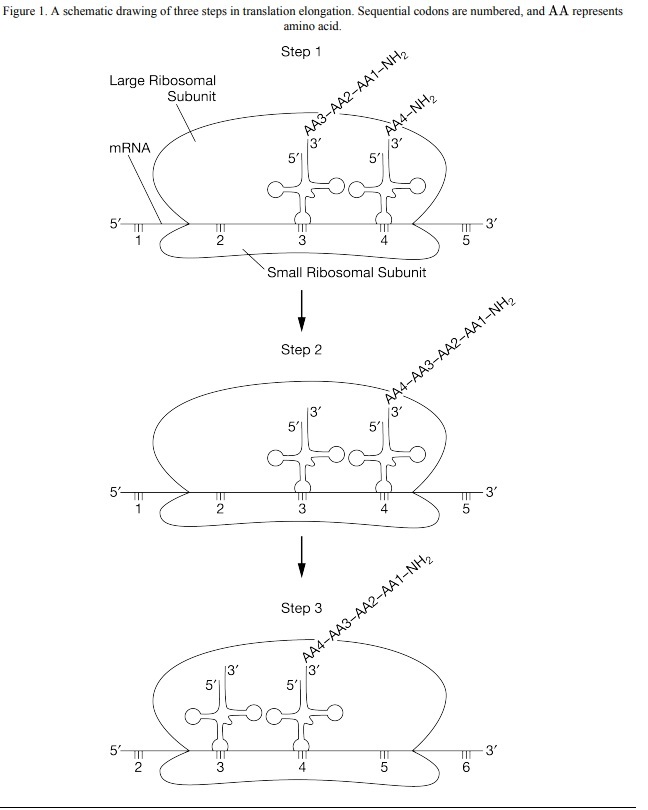
A processed eukaryotic mRNA (lacking introns) is introduced into bacteria so that the bacteria can produce a large quantity of the encoded polypeptide. Translation of the mRNA to produce a polypeptide involves the binding of large and small ribosomal subunits to an mRNA. Each complete ribosome has three tRNA binding sites that align with three sequential codons in the mRNA. Three steps in the process of translation elongation, the addition of amino acids to a growing polypeptide chain, are illustrated in Figure 1.
Figure 1. A schematic drawing of three steps in translation elongation
Sequential codons are numbered, and AA represents amino acid.
(a) Describe why translation of an mRNA can start before transcription of the mRNA is complete in prokaryotes but not in eukaryotes.
(b) Referring to Figure 1, explain the process illustrated between Step 1 and Step 2.
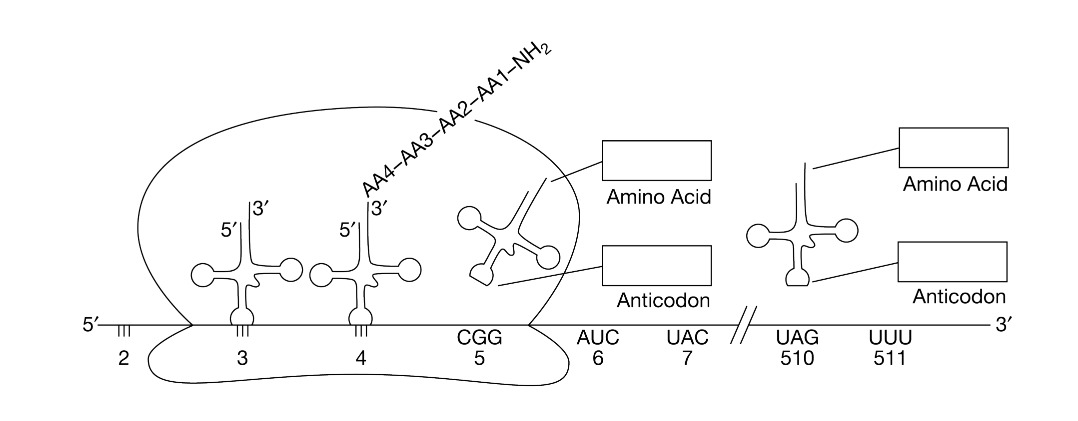
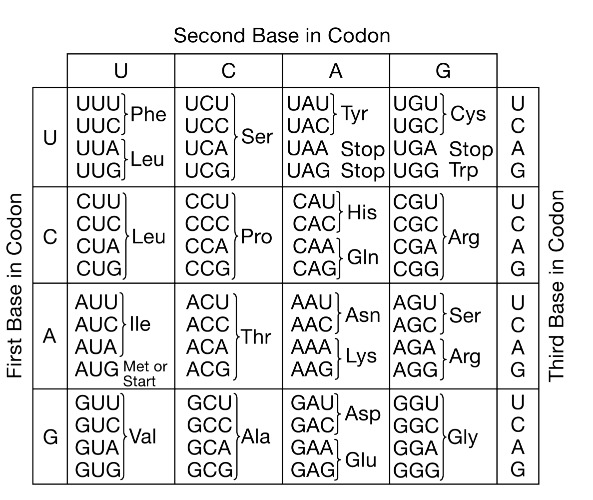
(c) Fill in the boxes in the template to identify the nucleotide sequence of the anticodon that will recognize codon 5 and the anticodon that will recognize codon 510 of the template and to identify the amino acids that will be added at these two positions. A codon table is provided for reference.
Figure 2. Ribosome showing codons 5–7 and codons 510–511
Use this figure to determine the appropriate anticodons and amino acids at codon positions 5 and 510.
Assume the following codons are found at the specified positions:
- Codon 5: CGG
- Codon 6: AUC
- Codon 7: UAC
- Codon 510: UAG (Stop codon)
Codon Reference Table
(d) Referring to the figures provided, explain why the polypeptide produced when the transformed bacteria translate the introduced eukaryotic mRNA provides evidence for the common ancestry of all living organisms.